Introduction: What Changed and Why 2025 Is Different
Dump truck aggregation has long relied on speed, relationships, and informal coordination. Text messages replace dispatch systems. Phone calls replace job documentation. Regular carriers fill daily demand. For years, these habits worked.In 2025, they no longer do.
Newly enforced labor laws in California have turned old operating habits into legal exposure. The issue is not intent. It is structure. When aggregation models control labor in practice, even unintentionally, they cross into employment territory. And once that happens, audits, penalties, and reclassification follow.
Dump truck aggregation is becoming a compliance risk in 2025 because operations did not evolve at the same pace as labor law.
 The Legal Shift: California’s Freelance Worker Protection Act (2025)
Effective January 1, 2025, the Freelance Worker Protection Act requires written agreements with clearly defined scope, pricing, and payment terms.
AB-5 and Worker Classification
AB-5 applies the ABC test, presuming workers are employees unless strict criteria are met to be treated as Contractors.
Effective January 1, 2025, California’s Freelance Worker Protection Act (SB 988) established clear, enforceable requirements for freelance and independent contractor engagements.
The law requires that freelance engagements be governed by a written agreement that includes, at minimum:
- The legal names and addresses of both parties
- A clearly defined scope of work
- Itemized pricing or rate of pay
- The method and timing of payment
- Clear delivery and settlement terms
In plain language, verbal agreements, text-message dispatches, and informal “we’ll settle later” arrangements no longer meet the legal standard.
For dump truck aggregators, this matters because work is typically assigned job by job, often with changing routes, rates, and timelines. Each of those jobs now requires job-level clarity, not blanket agreements or handshake deals.
AB-5 Still Governs Classification — and It Presumes Employment
Layered on top of the freelance law is California’s worker classification framework under AB-5, which applies the ABC test.
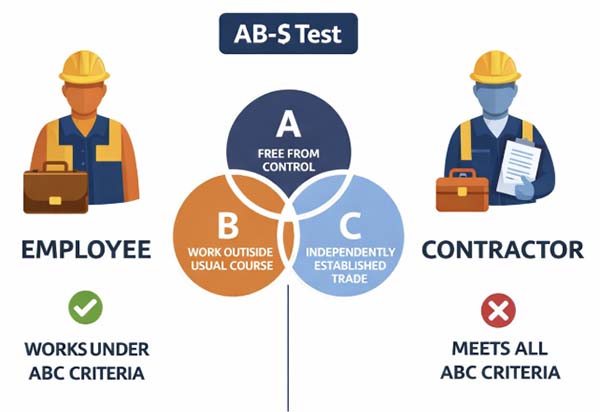
Under this test, a worker is presumed to be an employee unless all three of the following are true:
- A) The worker is free from the hiring entity’s control and direction, both in contract and in fact
- B) The worker performs work outside the usual course of the hiring entity’s business
- C) The worker is customarily engaged in an independently established trade
Dump truck aggregation models often struggle with A and B.
When an aggregator:
- Controls dispatch timing
- Dictates routes or delivery behavior
- Relies on the same drivers daily
- Manages settlements and pay informally
…it begins to look less like a marketplace and more like an employer.
AB-5 does not evaluate what companies intend. It evaluates how work is executed.
What used to be “operational flexibility” is now viewed as noncompliance.
Why Manual Dispatch Is a Compliance Problem
Manual dispatch of texts, calls, and ad hoc instructions is one of the biggest hidden risks in dump truck aggregation.
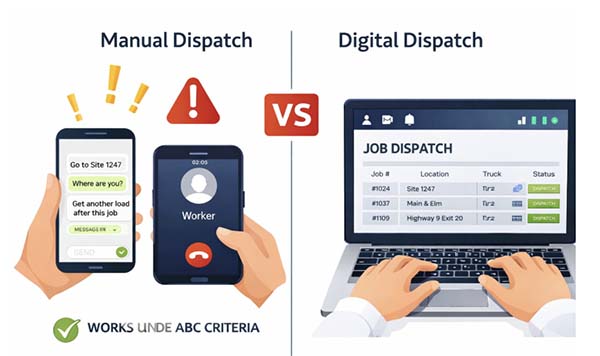
Here’s why:
- There is no written job scope
- Rates are often implied, not documented
- Payment timing is informal
- Job acceptance lacks proof of independence
Under the 2025 legal framework, these gaps are not operational quirks. They are audit flags.
When regulators examine dispatch records, they are looking for control. Manual communication creates exactly the kind of ambiguity that allows agencies to argue that drivers were directed, managed, and economically dependent.
What worked before now creates exposure.
The “Regular Contractor” Problem
Many aggregators rely on a small group of trusted, high-performing carriers. Operationally, this makes sense. Legally, it is dangerous.
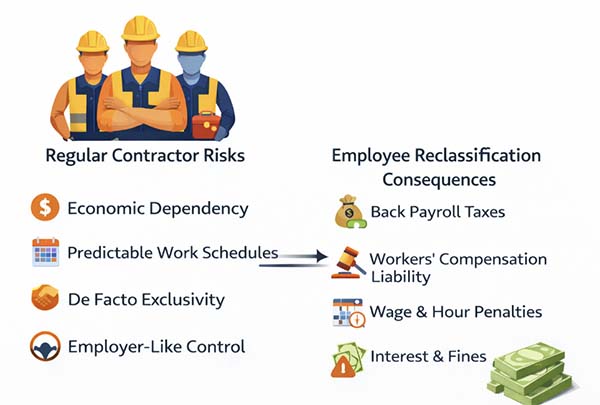
Daily reliance on the same contractors creates:
- Economic dependency
- Predictable work schedules
- De facto exclusivity
- Employer-like control
In audits, these workers are often reclassified as employees — retroactively.
Once reclassified, the fallout includes:
- Back payroll taxes
- Workers’ compensation liability
- Wage and hour penalties
- Interest and fines
In California, willful misclassification penalties can reach $25,000 per worker. At scale, exposure quickly reaches six or seven figures.
Why More Paperwork Doesn’t Fix the Problem
Many operators respond to compliance pressure by adding contracts, forms, and acknowledgments. Unfortunately, this rarely works.
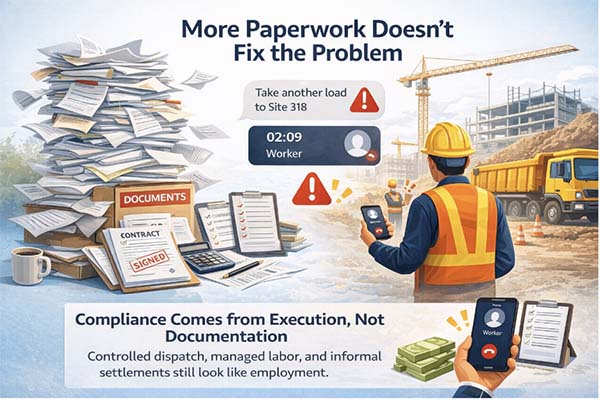
Compliance does not come from documents. It comes from operations.
If day-to-day execution still looks like employment — controlled dispatch, managed labor, informal settlements — no amount of paperwork will override reality.
Auditors examine:
- How jobs are posted
- How work is accepted
- How performance is monitored
- How and when workers are paid
If those systems reflect control over people instead of control over execution, misclassification risk remains.
Closed Networks + Informal Settlements = Tax Risk
Another overlooked exposure is tax compliance.
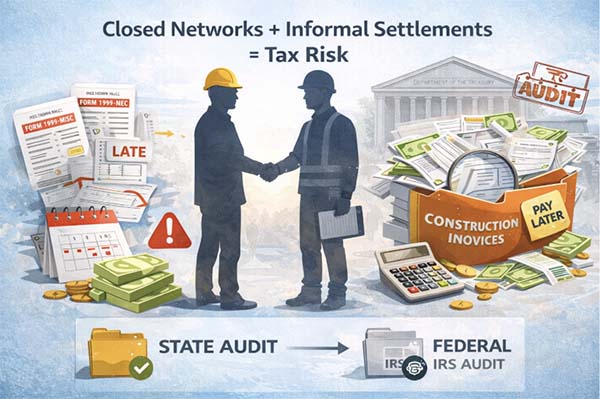
Closed contractor networks combined with informal settlements create:
- Inconsistent 1099 reporting
- Payment timing violations
- Cash leakage
- Reconciliation gaps
State audits frequently trigger federal audits. Once records are pulled, discrepancies compound quickly.
This is why many aggregators discover tax exposure only after a labor audit begins.
Controlling Workers vs. Controlling Execution
This distinction is the dividing line between compliant and non-compliant models.
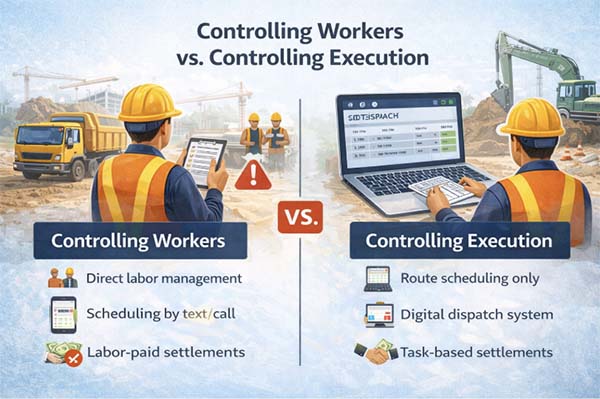
- Controlling workers: telling drivers how, when, and where to work, signals employment.
- Controlling execution: defining jobs, documenting outcomes, and settling digitally, does not.
High-performing, compliant operators shift control away from people and toward systems.
They:
- Post jobs publicly
- Allow independent acceptance
- Define scope digitally
- Track execution in real time
- Settle per job, not per relationship
Managing execution is not employment. Managing workers is.
Why 2025 Forces a Structural Change
The combination of:
- The Freelance Worker Protection Act
- AB-5 enforcement
- Increased audit coordination
means aggregation models must evolve.
The risk is no longer theoretical. It is operational.
Companies that continue to rely on:
- Manual dispatch
- Regular contractors
- Informal settlements
are not just inefficient. They are exposed.
The Path Forward: Embed Compliance Into Execution
The only sustainable solution is to fix execution, not just contracts.
Digitized job execution:
- Removes ambiguity
- Documents independence
- Enforces job-level clarity
- Market place and job level acceptance
- Reduces audit risk
- Improves cash flow
Compliance and efficiency are no longer separate goals. In 2025, they are the same objective.
Frequently Asked Questions (FAQs)
Is manual dump truck dispatch illegal in California?
Manual dispatch itself is not illegal, but when it results in control over workers, undocumented job terms, or informal payment practices, it creates significant compliance risk under AB-5 and the 2025 freelance law.
Do I need a written contract for every dump truck job?
Under the Freelance Worker Protection Act, freelance engagements require written agreements with defined scope and payment terms. Job-level clarity is increasingly necessary.
Can regular contractors still be used legally?
Yes, but heavy reliance on the same contractors can trigger reclassification if it creates economic dependency or control similar to employment.
Does adding more contracts solve misclassification risk?
No. Audits focus on how work is actually performed, not just what paperwork says.
What triggers a labor audit?
Common triggers include worker complaints, inconsistent tax filings, closed contractor networks, and informal settlements.
How can aggregators reduce compliance risk in 2025?
By shifting from controlling labor to controlling execution through transparent, digital, job-based systems.
Conclusion: The Risk Is Structural, Not Intentional
Dump truck aggregation is becoming a compliance risk in 2025 not because operators are doing something wrong, but because the rules have changed.
Old habits now create legal exposure. Informality now signals control. Efficiency shortcuts now trigger audits.
The future belongs to operators who understand one core truth:
Compliance doesn’t come from documents. It comes from execution.
Conclusion
Compliance in 2025 depends on execution, not intent. Operators must modernize systems to remain compliant.